I ended my report last year by suggesting there could not possibly be a worse year for the Consortium and the academy more generally than the year of bushfires and COVID-19, and hoping that subsequent events would not make a liar out of me. They did and they didn’t, as it turns out. The pandemic has dragged on for another year and we are now talking about its accommodation rather than its end. No travel has been possible and many of the dire economic consequences of the pandemic have been felt in this last year, not least constraints upon the resources that many of our members are dependent on and the decimation of academic staff. But we have made the adjustments we needed to make, and while in 2020 we were desperately calling things off and changing face-to-face events to online events at the last minute, this year we learned from experience only to program our events online. Though still in what feels like a holding pattern, we have remained active and been able to introduce some new initiatives that I trust will strengthen and expand the ACHRC in future years.
Name/Constitution Change
In the first three of its eight regular meetings in 2021, the Advisory Board discussed possible changes to the ACHRC constitution, in both senses of the word – changes to its make up and membership and changes to its formal constitution. This, in turn, has necessitated a change of name to better reflect the new membership: we now offer individual membership along with collective or centre membership and the Australasian Consortium of Humanities Research Centres has become the Australasian Consortium of Humanities Researchers and Centres. (The Board was unanimous that, having built a reputation and a ‘brand’ as a tertiary peak body, the Consortium should remain the ACHRC.) The Advisory Board sees these changes as a way of attracting new and different types of membership; we are now seeking to recruit more widely across the humanities, creative arts, and GLAM sectors – not just amongst university research centres and institutes, that is, but also amongst disciplinary societies, associations, networks, cultural institutions, and other relevant bodies. Our offering individual membership is a response, in large part, to the precariousness and ephemerality of research centres in today’s university, with many of our members having been obliged to fold during COVID. But it is also designed to attract members from areas underrepresented in the Consortium’s current membership, like ECRs, to whom the ACHRC offers opportunities for network building and research development, and for working with the GLAM sector.
The creation of a two-tiered membership – collective membership is $300 pa, individual membership $50 pa – has prompted discussion of a further tiering of Consortium membership to accommodate smaller and/or less well funded collectives. This is under consideration by the Advisory Board and we would welcome your input.
Personnel
Simon Burrows (WSU) and Grayson Cooke (SCU) joined us on the Advisory Board at the beginning of 2021, and have already made great contributions to our discussions and events, and only recently we welcomed Ros Smith, Director of the Centre for Early Modern Studies at ANU. We look forward to imposing on her mercilessly for at least three years. Thomas Nulley-Valdés started as the new Research Manager of the ACHRC at the beginning of this year, taking over from Katie Cox, who held the position in 2019 and 2020 before she took a job with the Australian Research Council. As this is also my last year as director, let me take this opportunity to thank all of the Advisory Board for their commitment and enthusiasm, and especially to thank Katie and Thomas for their tireless and inventive contribution to the Consortium and its activities. Every member of the Advisory Board who has got to know Thomas over the last year will attest to his energy, skill, and organisation in the job, as well as to his unfailing courtesy, and I know we all wish him the very best. Thomas, too, has recently accepted a position with the ARC and will wind up after generously taking two days off to help us out with the Annual Conference and AGM. (I’ll leave you to draw your own inferences from our having lost two excellent managers and early career scholars to the ARC.)
Recruitment
A recruitment drive that Thomas and I carried out in the middle of the year, in which we wrote to well over 50 research centres, has brought us half a dozen new centres – including the Centre for Early Modern Studies (CEMS) at ANU, Creativity Research, Engaging the Arts and Transforming Education (CREATE) at the University of Sydney, the Centre for Creative and Cultural Research (CCCR) at University of Canberra, the Centre for Human Rights Education at Curtin, and the Assemblage Centre for Creative Arts at Flinders – as well as half a dozen new individual members. Welcome everyone. I hope by now I don’t have to remind you to let us know if you have any questions or suggestions.
Expanding the ACHRC: GLAM and Creative Arts
The second phase of recruitment, targeting bodies in the GLAM sector, has yet to commence, but Thomas has compiled a list of potential members and contacts across Australia and New Zealand. Related to this, the board discussed the need to communicate the value of ACHRC membership to creative arts scholars and centres (which would also be of benefit to the Consortium’s recruitment in GLAM). An Advisory Board working group to discuss how the ACHRC might extend or adjust its activities to better accommodate the creative arts and to consider the next phase of our recruitment process has been established, with input from ACHRC member, Jen Webb (University of Canberra). So far it has been agreed, in the first instance, that a special panel be convened at the Annual Conference on the ‘Humanities, Creative Arts, and the GLAM sectors’ and that the ACHRC needs to engage in conversations with a number of peak bodies in both the creative arts and GLAM sectors about what ethical engagement and collaboration between these and the ACHRC might look like. This should also, in turn, set the agenda and priorities for a more informed and targeted recruitment strategy.
Subscriptions and Financial Situation
You will recall that in 2020 it was decided not to ask for subscriptions because many of our member centres and institutes were inhibited in their activities and threatened with a severe loss of income because of the pandemic. Most universities lost so much in fees by remaining inaccessible to international students that for some years now they are likely to run a substantial deficit. It was for this reason, as well as the fact that online meetings and events could be carried on at minimal cost, that the ACHRC Advisory Board decided to have an effective moratorium on subscriptions until 1 July 2021. This year we are again seeking subscriptions, however, to cover the (reduced) cost of maintaining the Consortium and to try and build up equity ahead of future activities, at the same time issuing a mission statement about our activities and the importance of the ACHRC as a peak body.
The main expenditure for the ACHRC is the fractional salary (0.2 FTE) of a Research Manager to look after administration and the organisation of events, but this has been covered for the last three years by the College of Arts and Social Sciences at ANU, for which I would again like to express my gratitude to the Dean, Prof. Rae Frances.
Humanities in the Regions 2021
The ACHRC organises two regular events every year. The first is a colloquium we call Humanities in the Regions, because we are keen to support regional universities where the humanities are under threat. Like last year, faced again with the uncertainties of COVID, the Board agreed to go ahead with the event in a modified format. Again it was online and again Victoria Kuttainen stepped up to do the lion’s share of the organisation – especially the choice of, and correspondence with, speakers. For those members who were unable to join us, the theme of the event this year was (wait for it) ‘Humanities from the Regions’, in which we made the concept or category itself our title and exploratory object, inviting speakers to consider humanities in the regions either in themselves or in light of one or more ‘posts’: post-Mabo, post fee-restructuring and Jobs Ready Graduate Funding, post-pandemic, post-whatever they chose. Though less ambitious than the virtual conference Victoria had brilliantly organised and staged at and around James Cook University in 2020, with its variety of synchronous and asynchronous offerings, the compact virtual forum nevertheless proved highly successful.
The whole event was inspired by Henry Reynolds’s Roderick Memorial Lecture “Seeing History from the North Down”, delivered at JCU in 2019, a lecture which addressed the unique and valuable perspectives that being a regional academic or doing humanities research and teaching in regional Australia brings to the humanities.Robert Clarke from UTAS delivered the first keynote as a scholar working in Tasmania and directing the (now defunct) Centre for Colonialism and its Aftermath. In the lecture he considered what he saw as some of the challenges for humanities research post-pandemic and in the wake of the culture of industrial restructuring which has dominated the sector. With a focus on doing literary research, Robert reflected on the value of location in shaping one’s career. Our other keynote, Jennifer Deger from the Northern Institute, Charles Darwin University, reflected on an on-going experiment in giving form to new kinds of collective thinking in the context of co-creative research in Arnhem Land, drawing on materials produced by Miyarrka Media, an arts collective that Jennifer co-founded with Paul Gurrmuruwuy more than a decade ago.
The forum also included a mixed panel of senior researchers, early career researchers, HDR and undergraduate students discussing the current challenges involved in researching and teaching the Humanities in a regional university.
The names of all the participants and videos of the keynotes are available on the ACHRC website: http://www.achrc.net/2021-humanities-in-the-regions/
Annual Conference and AGM 2021
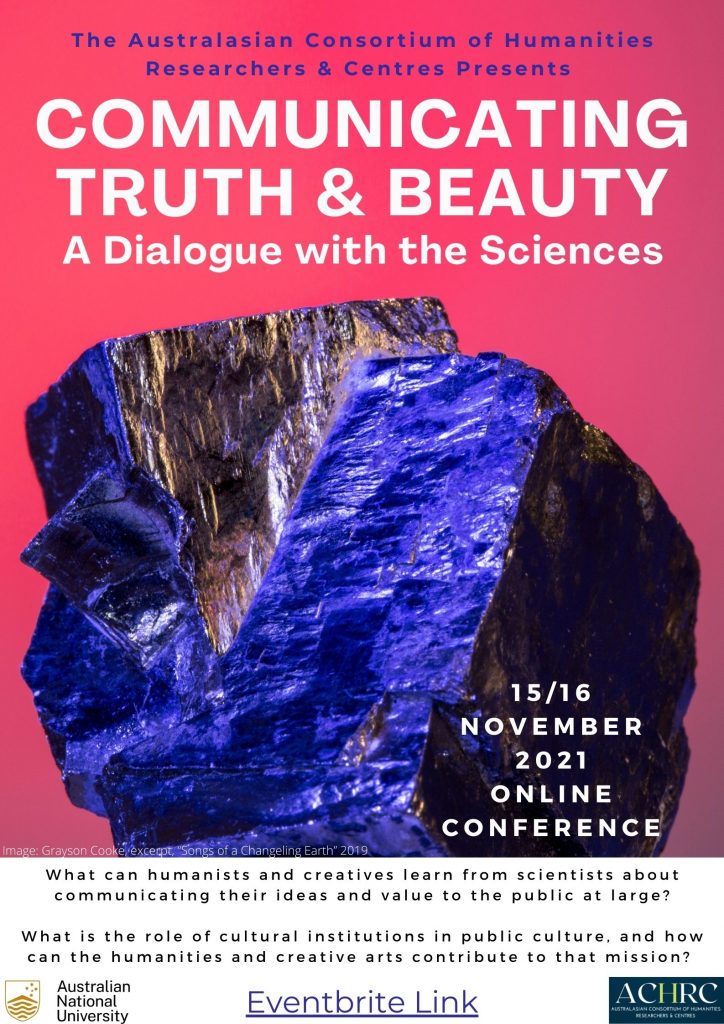
The other regular event is our Annual Meeting, a conference-style program with presentations alternating with panels on specific challenges facing both institutions and individuals in the humanities and creative arts. This year it is being ‘hosted’ as a virtual conference by the ANU on 15 and 16 November and the theme and title is ‘Communicating Truth and Beauty: A Dialogue with the Sciences’, featuring keynotes from Ian Gibbins, neuroscientist and (retired) Professor of Anatomy at Flinders and now a widely published and exhibited poet, video artist, and electronic musician, and Susannah Elliott, CEO of the Australian Science Media Centre. The conference has been organised by the ACHRC to reflect on the ‘gulf of mutual misunderstanding’ between the humanities and the sciences that C. P. Snow talks about in his (in)famous Two Cultures lecture, bringing together a selection of scientists, humanists, and creative artists to tell us how the different disciplines can, in fact – and indeed often do – relate better to each other than is generally allowed, and, when it comes to communicating with the public at large, to tell us what we can learn from each other. There will be panels on interdisciplinary initiatives, on ‘What the Humanities and Creatives Arts Can Learn from Science Communication’, and on ‘Creative Arts Engagements with Science and Science Infrastructure’.
And it is also our opportunity to hear again from the Academy of Humanities, the Royal Society of NZ, the Council of Humanities and the Social Sciences, and Australian Research Council about recent trends and initiatives in the humanities and funding opportunities.
I am particularly indebted to Robert Phiddian and Grayson Cooke, as well as to Thomas, for their input and activity on the working party for this year’s conference.
Everything you always wanted to know about Digital Humanities, but were too afraid to ask
Simon Burrows and Tully Barnett organised and chaired a 4-week introductory seminar series on Digital Humanities across four consecutive Fridays in September, each of which involved an informal intervention on a different aspect of DH studies by one or more speakers with a discussion afterwards: ‘DH Now (a state of the art)’, with Simon Burrows and Tully Barnett; ‘DH Pedagogy’, with Katrina Grant and Erin McCarthy; ‘DH and the Researcher’, with Rachel Hendery and Tim Sherratt; ‘DH and Research Design’, with Kath Bode, Terhi Nurrmikko-Fuller, and Ray Siemens. Originally planned to take 45 minutes – the emphasis was on brevity and accessibility – it soon became very clear that the audience was keen and had lots of questions and comments, so sessions were quickly extended to an hour. Simon and Tully are to be congratulated on the success of the seminars, with around 40-50 attendees in each session and around 1,000 visits to the Eventbrite page for each event. Audience participation was also very good, and generated greater visibility on social media, particularly Twitter.
The Weekly Seminar Series
So successful, indeed, were the DH seminars that the Advisory Board is currently discussing how the series title “Everything You Always Wanted to Know About . . .” could serve as a template for future ACHRC series that could bring together leading scholars from a particular field related to the ACHRC’s mission for informal discussion.
It was agreed that the discussion format is very attractive, making it more accessible than a traditional half-day workshop or conference format. The shorter format helps with Zoom fatigue, yet also addressing the need to connect. It was felt that events such as this can be seen and promoted as professional development opportunities (we could even include a session on how to successfully run a research collective) and could be valuable for regional academics for whom networking with other academics is quite challenging. Series such as these also offer a manageable labour model for ACHRC board members, and we might ask two members to coordinate a seminar series once every two years. Holding sets of weekly seminars at different times throughout the year is also an excellent way for the ACHRC to remain visible to its members and to the public.
Some suggested sessions for 2022 were:
– ‘Everything You Always Wanted to Know About Creative Arts Research’
– ‘Everything You Always Wanted to Know About Indigenous Research’
– ‘Everything You Always Wanted to Know About Public Humanities’
– ‘Everything You Always Wanted to Know About Private Sources of Funding’
The coronavirus has offered us the opportunity to meet in a way that money, time, and distance have inhibited or prevented us from doing in the past, so I welcome suggestions from all members for virtual symposia which cost only the time and energy we are willing and able to invest.
The Impact of the Jobs Ready Graduate Legislation
Advisory Board member Victoria Kuttainen has been gathering data examining the impact of the Jobs Ready Graduate legislation on trends in enrolment into Bachelor of Arts, humanities, and creative arts disciplines. Victoria got in contact with researchers Professor Sarah O’Shea and Paul Koshy from the National Centre for Student Equity in Higher Education, at Curtin University, which has also been looking into these enrolment trends, and we are currently putting together a working party that might connect with CHASS and the Academy of the Humanities.
ACHRC website
Thomas has been busy refreshing and rephrasing material on the ACHRC’s website, which has undergone a progressive rebranding of logos and content, with the posting of information about our events in 2021. The Member Directory has also been updated, though the details of some centres we have not heard back from have yet to be corrected or removed, as we are unsure of their status or their capacity to pay their membership this financial year. I would urge all members to go to the website page and check on their details and let us know of any corrections or exclusions that are necessary. Bookmark the link, because now that we have a more functional website we plan to use it more effectively to display upcoming events and to develop new resources, as well as to publicise the achievements ACHRC members.
Portfolios
The ACHRC is interested in all practical and theoretical aspects of humanities and creative arts research in today’s research environment, but members of the Advisory Board have volunteered to attend to specific areas of interest that we consider priorities: Humanities in the Regions; Humanities in Cultural Institutions; Early Career Researchers and Postdoctoral Fellows; Research Policy and National Response; Public Humanities. The Advisory Board will be revisiting these portfolios in an upcoming strategy meeting and I would ask every member, firstly, to consider whether the current portfolios are representative of what the ACHRC seeks to do, and, secondly, whether there are additional areas the ACHRC might seek to prioritise.
Strategic Planning Meeting
As I suggested in the previous section, the Board has agreed on the need for an out-of-session strategic planning day/workshop to be held in early to mid-December to consider the Consortium’s activities and advocacy in 2022 and beyond. A number of agenda items have been proposed – external grants, recruitment strategy, international activities (relations with Asian centres), portfolios, expending ACHRC funds, working with DASSH, HASS Congress 2022 – but I invite all members to propose items and to let me know if they would like to join us for some or all of the workshop.
The Future of the ACHRC
This is the last year of my directorship and 2021 the last year the ANU will be hosting the ACHRC, and a new host institution (with funding for a position of Consortium manager) will need to volunteer to take over at beginning of 2022. Succession in hosting the ACHRC is paramount and I have asked Advisory Board members to consider who might be interested in taking over for the three-year term from 2022 to 2024. I invite anybody who has questions to contact me. As I have noted, the most substantial funding the ACHRC needs is a 0.2 Full-Time Equivalent (FTE) position to assist with the management of the Consortium and I am more than happy to take questions and offer any advice.
Which makes this the last time I will be writing the annual report on ACHRC activities. My sincere thanks, again, to all the Advisory Board and to Thomas Nulley-Valdés, with all of whom it has been a pleasure to work over the last four years.
Will Christie
ACHRC Director
14 November 2021